Case study

A Premium Hospital Website Built Around Clearer Patient Access

We redesigned Ruby Hospital Kampala’s website to help patients find care, specialists, appointments and locations with less friction across every device.

Client
Ruby Hospital Kampala
Scope
Healthcare Website Redesign and Digital Patient Access
Visit live website

01 / Overview

The brief behind the project

Ruby Hospital Kampala needed a website that could represent a busy multispecialty hospital without transferring its operational complexity to patients. The project brought departments, services, specialists, appointments, emergency contacts, locations and patient information into a clearer digital experience. The aim was to help a visitor understand where to go, who may be relevant and what action to take next. Premium visual design mattered, but usability mattered more. The finished experience combines a refined interface with practical patient pathways across mobile, tablet, laptop and desktop screens.

Client
Ruby Hospital Kampala
Sector
Healthcare / Private Hospital
Location
Kampala and Entebbe, Uganda
Scope
Healthcare Website Redesign and Digital Patient Access

02 / Across Devices

The experience holds together at every size

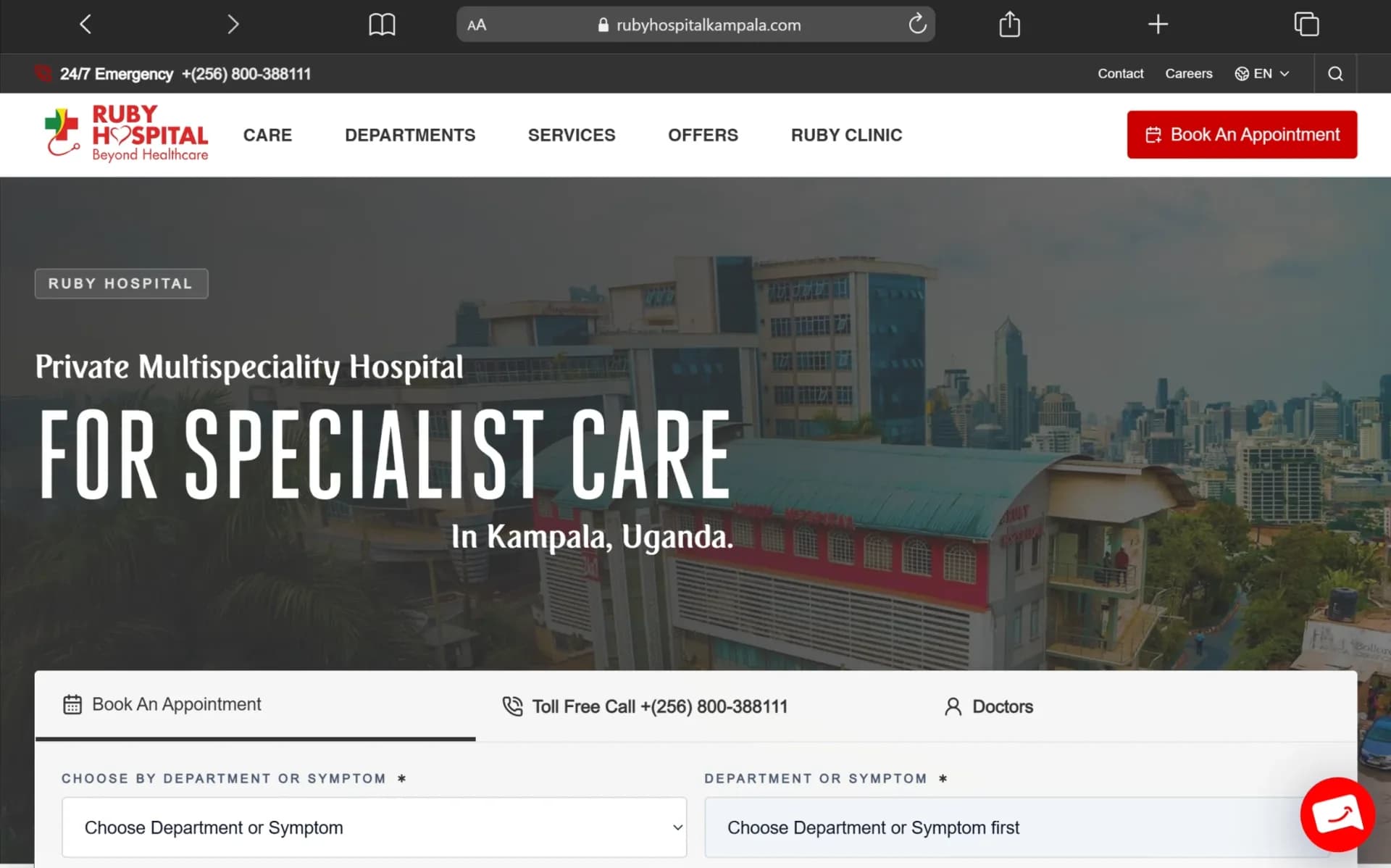
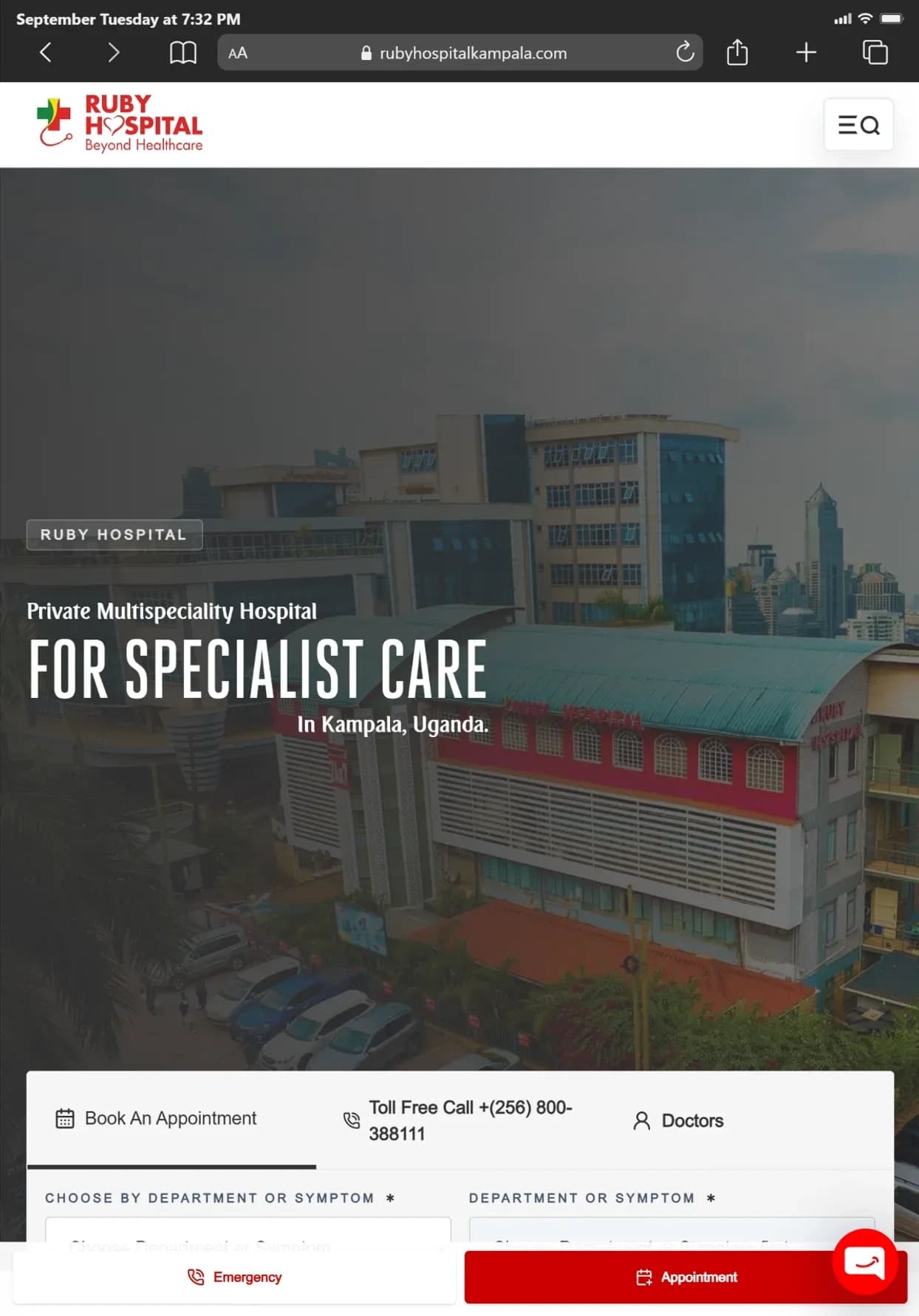
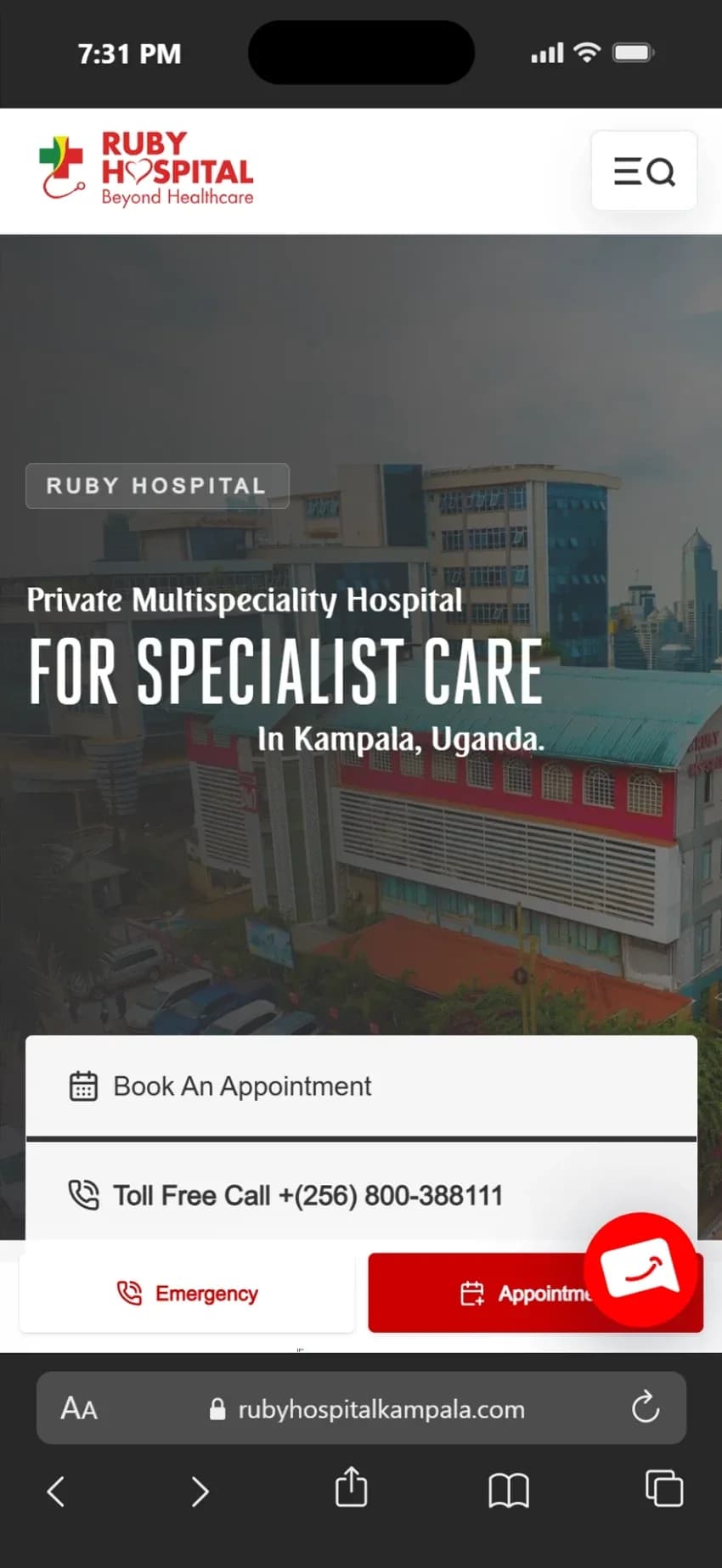
Independent captures show how the finished work holds together from desktop to mobile.
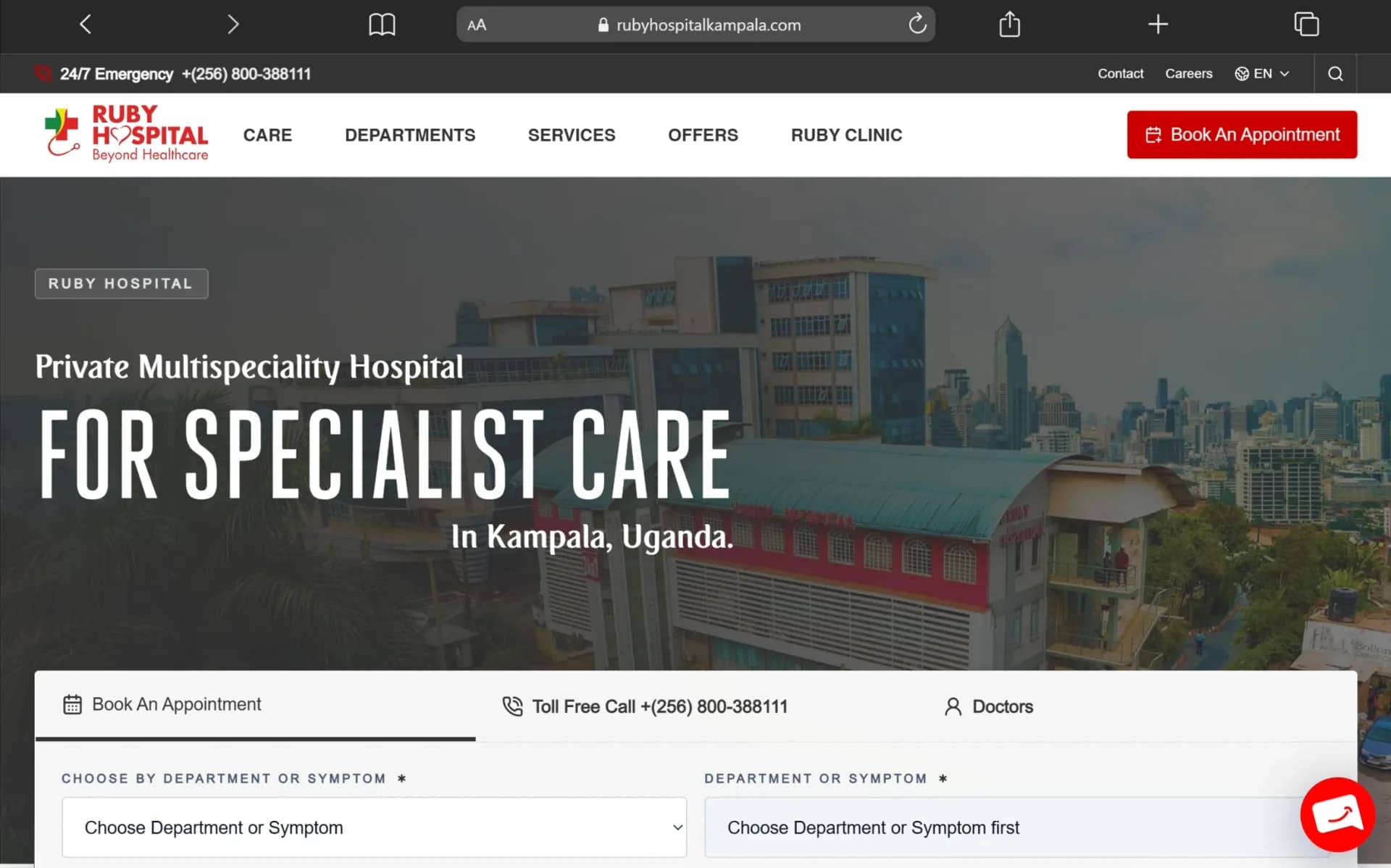
Ruby Hospital Kampala desktop website showing healthcare navigation and appointment access
Desktop view
Ruby Hospital Kampala website displayed on a laptop with services and appointment pathways
Laptop view
Ruby Hospital Kampala responsive tablet website showing specialist care and patient access
Tablet view
Ruby Hospital Kampala mobile website with specialist care, appointment and emergency actions
Mobile view

03 / Challenge & Approach

What needed to change, and how

The Challenge

Premium Design Built for Hospital-Level Complexity

The design brief called for the polish and confidence associated with premium international digital brands such as Emirates, without copying another brand’s interface. Ruby Hospital also had a much harder information problem to solve: many departments, specialists, diagnostic services, locations and patient needs had to work within one coherent experience. Busy professionals needed to find useful information quickly. Patients arriving with a health concern needed clear routes to care, while emergency contacts, appointments and specialist discovery required stronger priority than ordinary website content. The challenge was therefore not a cosmetic redesign. It was to make a complex hospital feel clear, credible and easy to navigate while maintaining a premium standard across every screen size.

  • Make hospital services easier to discoverOrganize a large range of care around clearer patient needs so visitors can find relevant services without first understanding the hospital’s internal structure.
  • Connect patients with departments and specialistsCreate logical relationships between care areas, services and doctors so a visitor can move from a health concern toward relevant clinical expertise.
  • Create clearer appointment pathwaysReduce the distance between researching care and taking action by making appointment access visible at the points where intent is highest.
  • Prioritize emergency and contact informationKeep emergency, toll-free and other important contact actions easy to identify, especially for visitors using smaller mobile screens.
  • Support Kampala and Entebbe locationsPresent location information as part of the patient journey so visitors can understand where care is available and which facility they need.
  • Present complex medical information clearlyStructure healthcare content for easier scanning and understanding while keeping the professional tone and accuracy expected from a hospital.
  • Design for every major screen sizeProtect navigation, readability and important patient actions across mobile, tablet, laptop and desktop layouts.
  • Create room for future growthUse reusable content and interface patterns so more departments, specialists, services and patient information can be added without weakening consistency.

Our Approach

Patient Questions Shaped the Information Architecture

We developed the experience with input from the hospital’s creative, IT and content teams, executive stakeholders, doctors and reception staff. Each group contributed a different view of how patients discover the hospital, what information they need and which questions repeatedly reach frontline teams. Those conversations helped shape the information hierarchy and patient journeys. Departments, services, specialists, appointments, emergency contacts and locations were treated as connected tasks rather than isolated pages. The interface was then refined around clarity, spacing, responsive behaviour and visible next actions. This allowed the premium visual direction to support usability instead of competing with it.
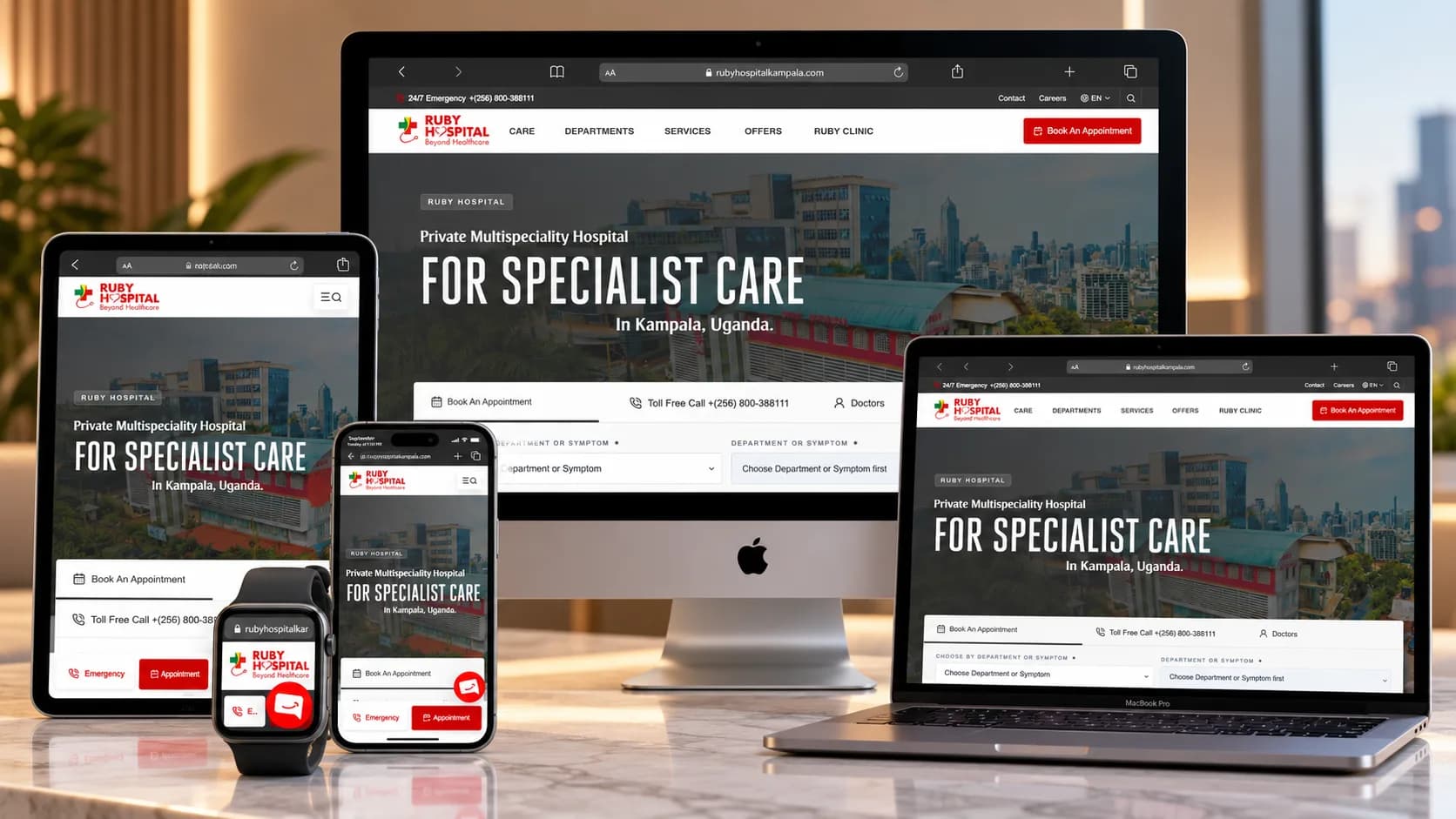
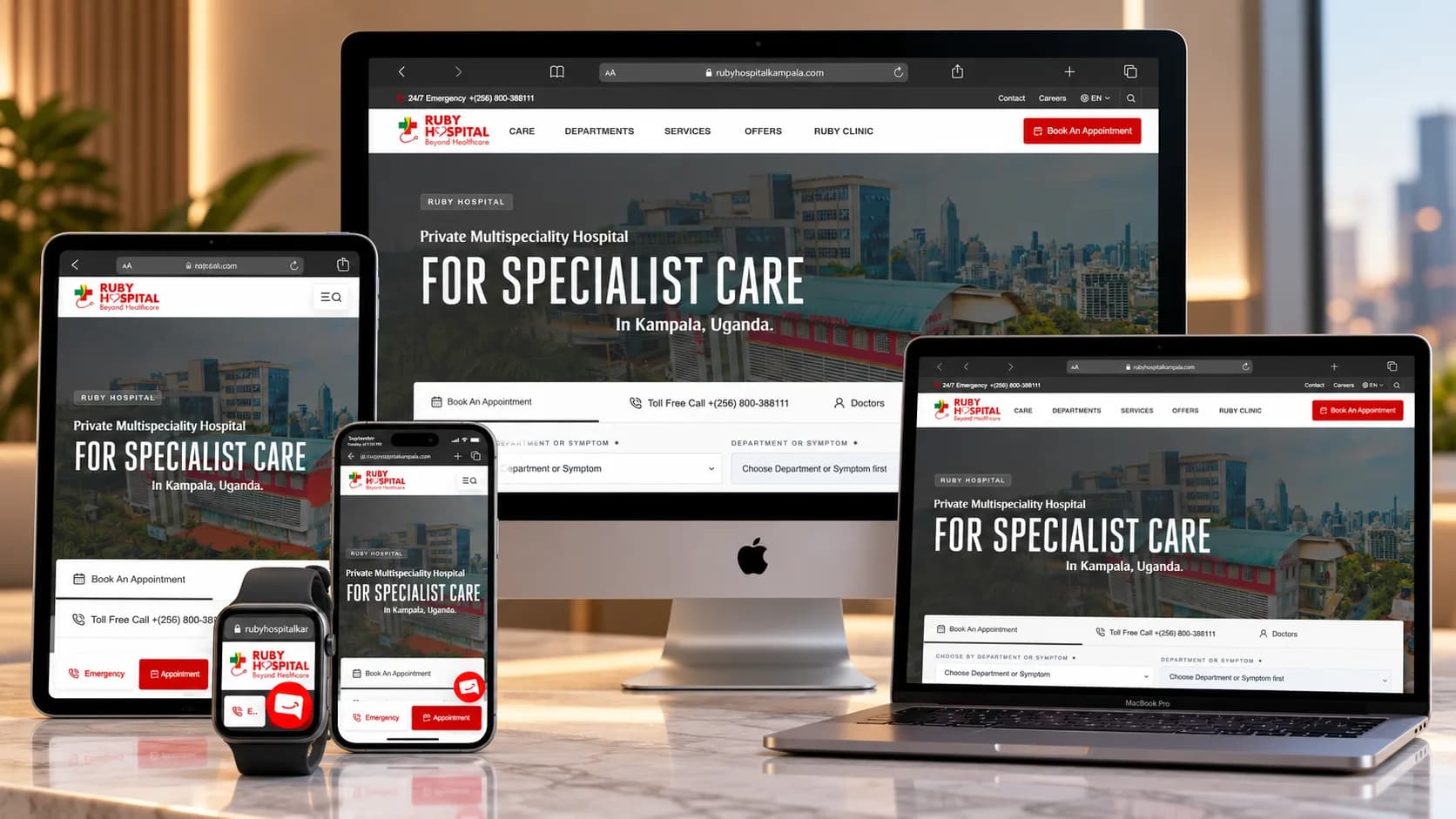
Ruby Hospital Kampala responsive website presented across Apple-style desktop, laptop, tablet, phone and watch mockups
  • Learn from frontline hospital teamsDoctors, reception staff, executives, creative, IT and content teams helped identify recurring patient questions, information gaps and operational priorities.
  • Organize around patient intentStructure the experience around finding care, understanding options, locating specialists and taking the next action rather than mirroring internal departments alone.
  • Reduce cognitive loadUse hierarchy, spacing and focused actions to help visitors process a large amount of healthcare information without feeling overwhelmed.
  • Make responsive design part of the serviceTreat mobile, tablet, laptop and desktop as deliberate experiences so critical information remains accessible instead of simply shrinking the desktop layout.
  • Simplify ongoing content managementGive hospital teams a more manageable CMS structure for routine content updates and continued expansion.

Delivered Solution

One Connected Digital Front Door for Patient Access
  • Responsive healthcare experienceA consistent interface carries the hospital’s visual identity and key patient actions across mobile, tablet, laptop and desktop devices.
  • Connected care discoveryDepartments, services and specialist information work together as part of a single discovery journey rather than separate content silos.
  • Visible next actionsAppointment, emergency, toll-free and location pathways are positioned where patients are more likely to need them.
  • Simplified publishingA streamlined CMS supports ongoing updates as hospital information, services and patient resources change.

Design system

A visual system built for clarity

TypographyResponsive typography hierarchy designed for fast scanning across healthcare content
Colour palette
Interface elements
  • Responsive navigation
  • Department and service navigation
  • Specialist and doctor discovery
  • Appointment actions
  • Emergency and toll-free contact actions
  • Location pathways
  • Healthcare content sections
  • Responsive forms
  • Mobile action bar
  • Reusable CMS content patterns

04 / Showcase

The finished work, in context

Real page captures let the work speak for itself.
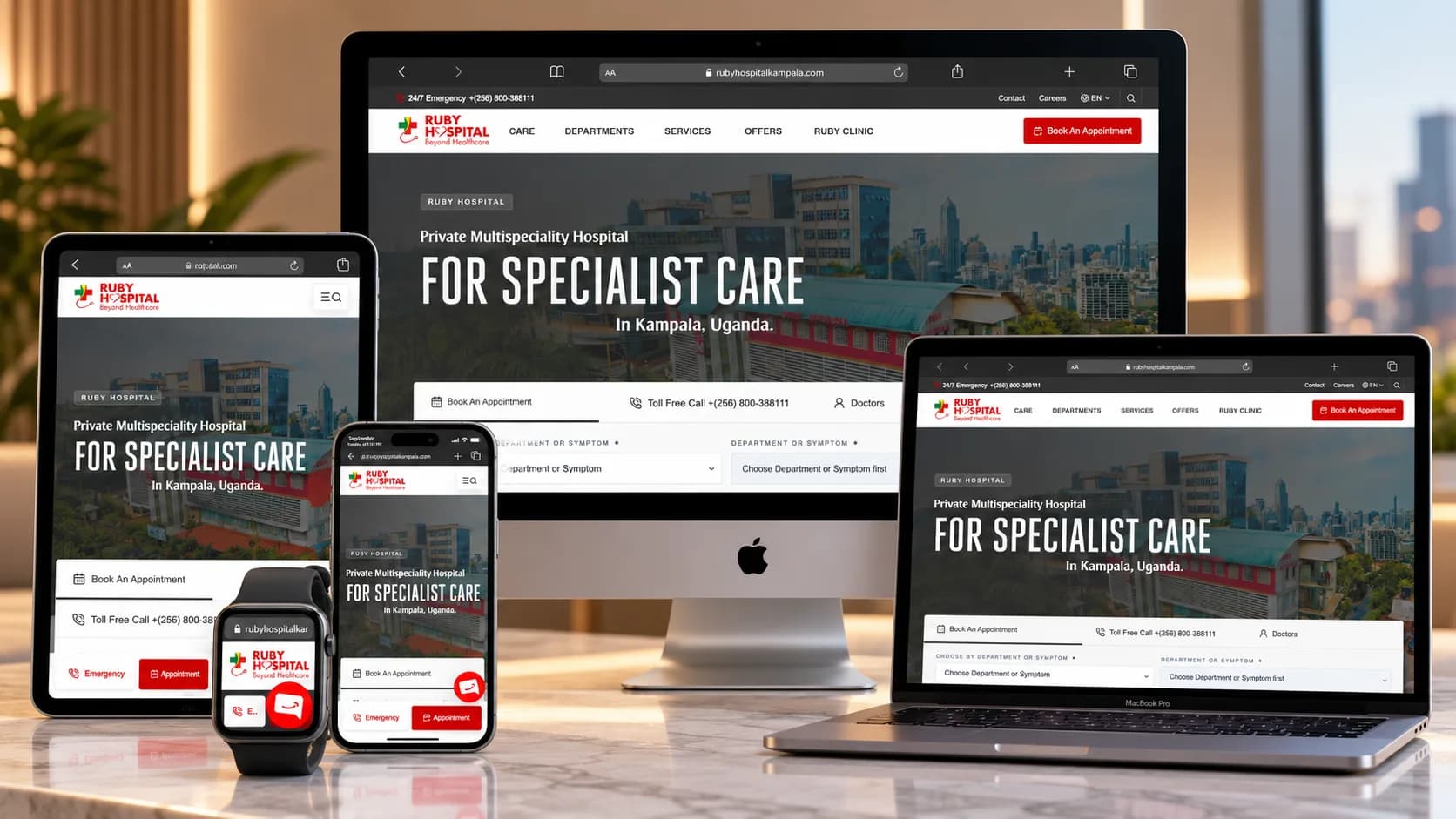
Ruby Hospital Kampala responsive website redesign across multiple devices
Ruby Hospital KampalaPrimary project view
Ruby Hospital Kampala responsive website presentation mockup 1
Ruby Hospital KampalaProject view 1

Development

Built to be useful beyond launch

The project was implemented in Next.js and structured around a simplified content management experience for ongoing hospital updates. Development translated the approved patient journeys into responsive layouts that remain useful from mobile to large desktop screens. Particular attention went to navigation, service discovery, appointment access, emergency actions and consistent presentation across content-heavy pages. The CMS was simplified so hospital teams could continue managing changing information without turning routine content updates into a development task.

  • Next.js
  • Responsive patient-first interface across mobile, tablet, laptop and desktop
  • Department and healthcare service discovery
  • Doctor and specialist discovery pathways
  • Online appointment access
  • Emergency and toll-free contact actions
  • Kampala and Entebbe location pathways
  • Healthcare content structured for easier scanning
  • Simplified CMS for ongoing hospital content updates

05 / Outcomes

What the work made possible

  • Project delivered in 3 weeks
  • Live responsive website across mobile, tablet, laptop and desktop experiences
  • Simplified CMS for ongoing hospital content management
  • Departments, services and specialists organized into clearer discovery pathways
  • Appointment, emergency and toll-free actions given stronger visibility
  • Patient journeys informed by input from doctors, reception staff, executives, creative, IT and content teams
  • Delivery: Completed in 3 weeks
  • Responsive experience: The interface adapts across mobile, tablet, laptop and desktop layouts.
  • Patient access: Services, specialists, appointments, emergency contacts and locations are presented as connected patient pathways.
  • Content management: A simplified CMS supports ongoing hospital content updates.
  • Stakeholder-informed UX: Patient journeys were shaped with input from hospital leadership, doctors, reception, creative, IT and content teams.

Have a similar challenge?

Let’s build a digital system that moves your business forward.

06 / FAQ

Frequently asked questions

What did Trophy Developers redesign for Ruby Hospital Kampala?

We redesigned the hospital’s responsive digital experience around clearer access to services, specialists, appointments, emergency contacts, locations and patient information.

How long did the Ruby Hospital Kampala website project take?

The project was delivered in 3 weeks.

How did you handle a website with many hospital departments?

We used stakeholder input and patient questions to organize content around discovery and next actions instead of simply reproducing the hospital’s internal structure.

What technology was used for the website?

The project record identifies Next.js as the development framework and a simplified CMS for ongoing hospital content management.

Next step

Find the digital gaps costing your business customers, time, or revenue.

Start with a Digital Growth Audit. We review visibility, conversion, operations, payments, security, and measurement before recommending the right system.