Website Security Built Around Prevention, Recovery and Business Continuity
Website Security Services Uganda | Trophy Developers
Overview
Website Security
Business caseWhy Your Business Needs Website Security
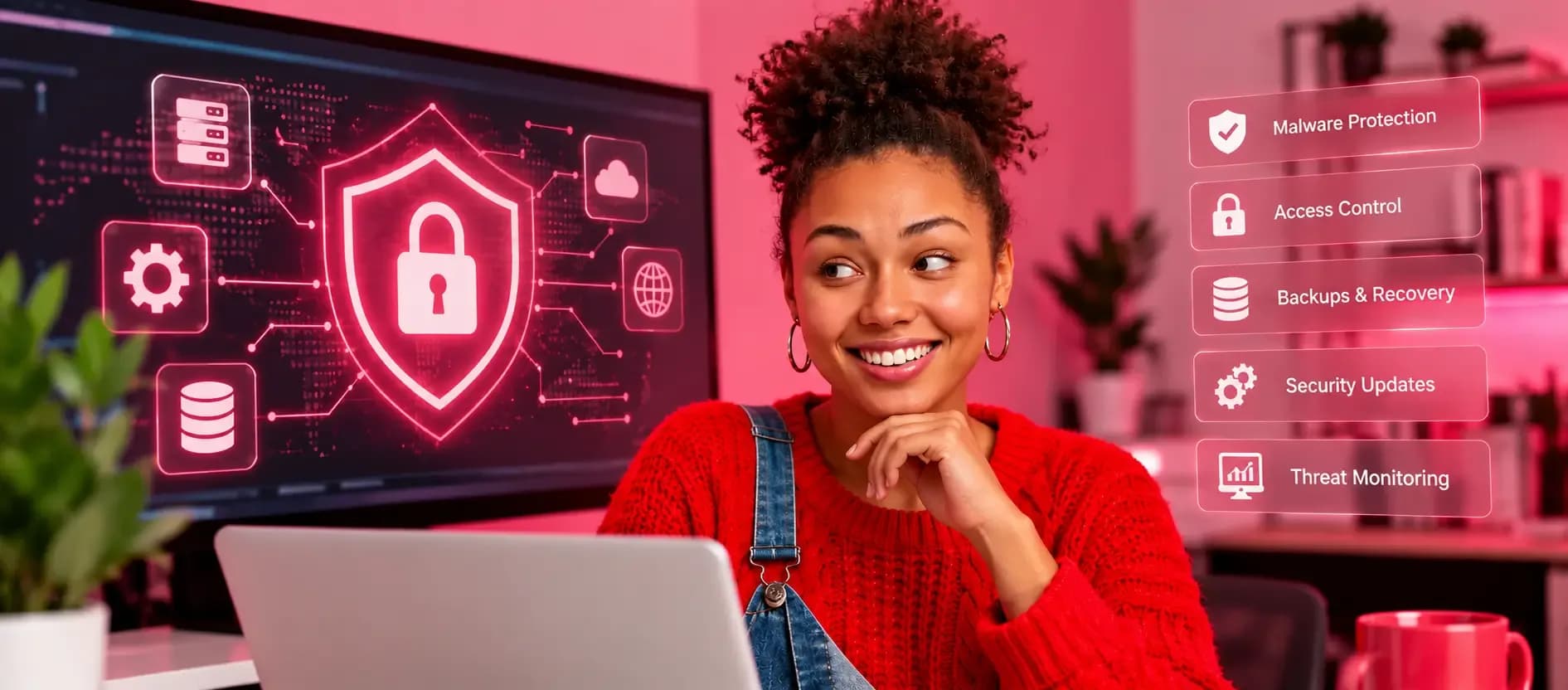
A business website should not become a weak point in your operations. Trophy Developers provides website security services in Uganda for businesses, organisations, public-sector entities and international teams that need stronger protection against malware, unauthorised access, vulnerable software, insecure configurations, data exposure, malicious traffic and preventable website failures. We assess the website, hosting environment, software, access controls, integrations and recovery readiness before recommending the security work that matters most.
OutcomeWhat the work should improve
We avoid presenting security as a generic checklist. The website, business process, hosting environment, access model and recovery readiness determine what needs attention first.
- Findings are prioritised by exposure, impact and business importance.
- Controls are matched to the actual website and architecture.
- Security changes are verified against important website journeys.
- Remaining risks and third-party dependencies are stated clearly.
Capabilities
What Website Security Includes
What Website Security Means for a Business
Website security is the combination of technical controls, operational practices and recovery planning used to reduce the risk of unauthorised access, malicious modification, data exposure and service disruption. A secure website is not created by installing one plugin or enabling SSL. Security can involve application code, CMS software, plugins, dependencies, hosting, DNS, HTTPS, administrator access, user permissions, APIs, forms, databases, backups, deployment processes, third-party integrations, monitoring and incident response.
Website Security Is About Risk Reduction, Not Impossible Guarantees
No responsible provider can promise that a website will never experience a security incident. Websites depend on many systems, people and external services. The objective of website security is to reduce preventable weaknesses, limit exposure, detect suspicious behaviour earlier and improve the organisation's ability to recover. Trophy Developers focuses on controls that can be explained, implemented and verified.
Who Our Website Security Services Are For
Our website security services can support small businesses, SMEs, established companies, e-commerce businesses, professional firms, NGOs, institutions, government agencies, public-sector entities, international organisations, marketing teams, internal IT teams and businesses inheriting older websites. The security scope is adjusted to the website, architecture, information handled and operational importance of the system.
Website Security Problems We Help Address
A website may require security work when there are signs of weakness, compromise or poor operational control. We begin by identifying the actual risk instead of applying the same checklist to every website.
Website Security Assessment
We review the website and its environment to identify important weaknesses, outdated components, risky access patterns and missing controls. A review can include website technology, CMS software, plugins, dependencies, hosting, DNS, HTTPS, user access, backups, integrations, forms, security headers, error exposure, deployment practices and monitoring. The objective is to prioritise real issues rather than generate a long list without business context.
Website Security Hardening
Security hardening reduces unnecessary exposure. Depending on the platform, hardening may include removing unused software, updating outdated components, restricting privileged access, strengthening authentication, reviewing administrator accounts, adjusting permissions, securing configuration, improving HTTPS behaviour, adding security headers, protecting administrative routes, improving form protections and reducing information leakage.
WordPress Security Services
WordPress security often requires coordination across the CMS, themes, plugins, hosting and administrator access. We can review WordPress core, installed plugins, themes, administrator accounts, PHP compatibility, file permissions, authentication, backups, forms, database access, malware indicators, redirects and update practices. Where a WordPress website has already been compromised, the first priority may be recovery rather than routine hardening.
Security for Custom Websites and Web Applications
Custom systems need security controls that reflect their architecture. Depending on the application, we may review authentication, authorisation, session handling, APIs, input validation, database access, environment variables, secrets, deployment, dependencies, error handling, logging, user roles and administrative interfaces. Custom applications should not be secured using only a generic CMS checklist.
Website Access and Administrator Security
One of the most important website security controls is deciding who can access what. We can help review administrator accounts, user roles, privileged access, shared credentials, former staff accounts, contractor access, password practices, multi-factor authentication where supported, recovery access and service accounts. Businesses should avoid allowing every website user to operate with full administrative privileges.
Protecting Website Forms
Forms can become targets for spam, credential attacks, malicious submissions, injection attempts, resource abuse and email abuse. Depending on the website, protections may include validation, rate limiting, anti-spam controls, secure processing, input sanitisation, authentication and access controls. The objective is to protect the form without making legitimate enquiries unnecessarily difficult.
Website Login Protection
Login areas often attract automated attacks. Security work can include stronger password requirements, multi-factor authentication, login rate limiting, account lockout policies, bot protection, restricted administration access, login monitoring and removal of unnecessary accounts. The right controls depend on the website and its users.
SSL and HTTPS Security
HTTPS protects data between the visitor and the website. We can review SSL certificate status, expiry, HTTPS redirects, mixed content, certificate configuration, domain coverage and redirect behaviour. SSL is important, but it does not make the whole website secure by itself. A website can use HTTPS and still contain vulnerable software, weak passwords or insecure application logic.
DNS and Domain Security
The domain and DNS layer are critical to website availability. Security considerations may include registrar access, DNS access, account security, domain expiry, DNS records, nameserver changes, unauthorised modifications and recovery access. Compromise at the domain level can redirect users even if the website application itself is secure.
Hosting Security
Website security also depends on the environment where the website runs. Hosting-related security can include server access, runtime versions, file permissions, firewall configuration, updates, logs, backups, resource isolation, HTTPS and deployment controls. The division of responsibility between Trophy Developers, the client and any external infrastructure provider should be clear.
Website Malware and Suspicious Code
Malware can modify website behaviour without being immediately visible. Signs may include redirects to unknown websites, popups, search spam, new administrator accounts, modified files, unusual scripts, suspicious database content, unexpected advertisements or search engine warnings. Where malware is suspected, the website may require an incident and recovery process rather than routine maintenance.
Hacked Website Recovery
If your website has already been compromised, security work changes from prevention to containment and recovery. Recovery can involve identifying affected files, reviewing suspicious accounts, comparing backups, removing malicious changes, restoring legitimate content, updating vulnerable software, resetting access, strengthening configuration and verifying important website journeys. Recovery depends on what still exists and the quality of available backups.
Website Backups and Recovery Readiness
Security is incomplete without recovery planning. A strong backup strategy can reduce the impact of malware, failed updates, accidental deletion, database corruption, hosting failure and developer mistakes. A backup plan should answer what is backed up, how often, where it is stored, how long it is retained, who controls it and whether restoration has been tested.
Security Updates and Patch Management
Outdated software can expose known vulnerabilities. Depending on the website, update management can include CMS core, plugins, themes, libraries, frameworks, packages, runtime versions and server software. Updates should be tested where they could affect important functionality. Security work should not create unnecessary downtime by applying uncontrolled changes.
Third-Party Dependency Security
Modern websites depend on external services such as payment providers, CRM systems, analytics, maps, email platforms, booking systems, authentication providers, APIs and CDN services. A weakness in an external dependency can affect the website. Security planning should therefore include the systems connected to the website, not only the website code.
API Security
APIs can expose business data and functionality. Depending on the system, API security may include authentication, authorisation, rate limiting, input validation, token handling, logging, error exposure and permission boundaries. API security becomes particularly important for customer portals, mobile applications and custom web platforms.
Database Security
Databases may contain sensitive business or customer information. Important controls can include restricted access, strong credentials, network restrictions, encrypted connections, least-privilege users, backups, logging and secure application queries. The specific database controls depend on the architecture and hosting environment.
Security Headers and Browser Protections
Browser security controls can help reduce certain classes of attack. Depending on the website, we may review Content Security Policy, Strict Transport Security, frame restrictions, MIME protections, Referrer Policy and Permissions Policy. These controls should be configured deliberately because incorrect settings can break legitimate website functionality.
File and Upload Security
Websites that allow file uploads require additional care. Risks can include executable files, oversized uploads, malicious documents, unsafe filenames and public storage exposure. Where uploads are required, controls should match the type of files and the way they are processed.
Payment and E-Commerce Security
E-commerce websites carry additional risk because they handle transactions and customer activity. Security work may involve checkout security, payment integrations, administrator access, customer accounts, session handling, product management access, webhooks, API credentials and transaction notifications. We also identify which parts are controlled by the website and which depend on the payment provider.
Protecting Customer and Business Data
Website security should consider the information the website collects, including names, email addresses, phone numbers, applications, form submissions, account information, transaction records or business documents. Security controls should be proportionate to the information handled. Where legal or regulatory requirements apply, organisations should also obtain appropriate legal or compliance advice.
Security Monitoring
Security monitoring improves visibility. Depending on the website, monitoring can include availability, login activity, security alerts, file changes, error logs, malware indicators, suspicious traffic and expired certificates. Monitoring does not prevent every attack. It helps organisations detect problems earlier and respond with more information.
Website Logs and Incident Investigation
Logs can become important when something goes wrong. Useful logs may include application errors, authentication events, server requests, deployment activity, security alerts and administrative changes. Logging should provide enough information for diagnosis without unnecessarily exposing sensitive information.
Website Security and Performance
Security controls should not make the website unnecessarily slow. Likewise, performance optimisation should not remove protections simply to improve a test score. We balance security and performance based on the actual architecture. Techniques such as caching, CDN services, bot controls and traffic filtering can sometimes improve both.
Website Security and SEO
Security problems can affect search visibility. A compromised website may redirect users, publish spam, create malicious pages, damage trust, trigger browser or search engine warnings, alter metadata or modify links. Protecting website integrity therefore also helps protect the business's search presence. Website security is not an SEO service, but the two can affect each other.
Website Security and GEO
AI systems and answer engines depend on accessible and trustworthy website information. A compromised website can distort service information, entity information, structured data, articles, FAQs and business facts. Security therefore supports the integrity of the digital information that search and AI systems may consume.
Website Security for Government and Public-Sector Websites
Public-sector websites can have additional responsibilities because they may serve large audiences and communicate important information. Security planning may need to consider governance, access control, department roles, content ownership, public availability, change approval, logging, recovery and third-party suppliers. The exact controls depend on the organisation and systems involved.
Website Security for SMEs
SMEs often need practical security without unnecessary complexity. The priority is usually to protect administrator access, customer enquiries, website availability, business email integrations, backups and important website content. A focused security plan can address these areas before adding advanced controls that the business does not need.
Website Security for International Organisations
Trophy Developers can support organisations operating outside Uganda where the website, hosting environment and required access can be managed remotely. This can include businesses entering Uganda or East Africa, regional organisations and international teams managing digital systems across multiple locations. The security scope remains based on the actual architecture and risk.
Our Website Security Process
We use a structured process that starts with the website and business risk, then moves through review, prioritisation, scope, implementation, verification and ongoing responsibility. This keeps security work connected to the systems and business journeys that matter most.
Security Findings Should Be Prioritised
A long vulnerability list is not automatically useful. Security findings should be prioritised by likelihood, impact, exposure, exploitability, business importance and recovery difficulty. A high-risk weakness affecting a checkout, customer account or business-critical workflow deserves different attention from a minor informational issue.
What We Need From Your Team
A useful security review usually requires the website URL, a technical contact, hosting information, CMS or application details, appropriate access, a list of important integrations, information about recent incidents, backup details and relevant error messages. Do not send passwords through a public contact form. Sensitive access should be shared through an agreed secure method.
Security Work We May Scope Separately
Some requirements may fall outside routine website hardening, including large penetration-testing engagements, formal regulatory audits, enterprise security architecture, internal network security, endpoint security, employee device security, corporate identity systems, physical security and legal compliance audits. Where a requirement sits outside our website scope, we identify that clearly rather than present it as included.
Website Security vs Website Repair
Website security focuses on reducing risk and strengthening controls. Website repair focuses on restoring something that is currently broken. If your website is already hacked, unavailable or malfunctioning, Website Repair Uganda may be the correct starting point. Security hardening can follow after the website is stable.
Website Security vs Website Management
Website management covers ongoing updates, monitoring, content work and technical support. Security can form part of website management, but deeper security reviews and incident work may require a dedicated engagement. Businesses with important websites often benefit from both security hardening and ongoing website management.
Website Security vs Hosting
Hosting provides the infrastructure. Website security covers the broader controls used to protect the website and its operation. A secure hosting environment does not automatically make insecure application code safe. Likewise, a secure application can still be exposed by poor infrastructure configuration. Both layers matter.
Why Businesses Choose Trophy Developers for Website Security
Website security is connected to development, hosting, maintenance, UX, SEO, integrations and business operations. Trophy Developers can assess the website in that wider context. Our approach focuses on understanding the actual system, identifying practical risks, prioritising important fixes, avoiding unnecessary changes, protecting business-critical website journeys, documenting what changed and connecting security findings to maintenance and recovery.
Website Security Reporting
Where included in the engagement, a security report can summarise the issue identified, affected system, risk level, evidence, recommended action, work completed, remaining risk and follow-up requirement. The report should distinguish between confirmed problems, observed weaknesses, recommended controls and external dependencies.
Build More Confidence in the Website Your Business Depends On
Your website should support the business without becoming an unmanaged security risk. Trophy Developers can review the website, identify important weaknesses, strengthen the agreed controls and define the next security priorities. If you are dealing with an active incident, tell us what happened. If you are planning ahead, start with a website security review.
Systems & frameworks
Tools and systems used for Website Security
CMS security
WordPress
Security review and hardening for WordPress core, plugins, themes, administrator access, backups, forms and hosting configuration.
Modern web applications
Next.js and React
Security review for application code, dependencies, environment configuration, authentication, APIs, deployment and connected services.
Infrastructure security
Hosting, DNS and SSL
Security review for server access, DNS, domains, HTTPS, certificates, redirects, backups and deployment controls.
Connected systems
APIs and Integrations
Security review for authentication, authorisation, tokens, webhooks, payment providers, CRM systems and other third-party dependencies.
Application security
OWASP-Informed Practices
Application security review informed by established web security practices, adapted to the website architecture and agreed scope.
Investment
Scope the work around what the project actually requires
Project estimator
Estimate your Website Security | Trophy Developers support path.
Choose the closest website security | trophy developers scope before sending your enquiry.
Explore
Related services and useful guides
Related Services
Proof
Relevant work and client reviews
Google Reviews
Client feedback from Google Reviews.
- Rated 5 out of 5 stars
From the start, they listened to what I needed and turned it into a clean, easy-to-use, and professional site that really showcases my farm work. The design is modern, mobile-friendly, and makes it simple for my customers to learn about our products and get in touch. The team was responsive, creative, and delivered on time. I’m proud to share my website with clients and partners now. Thank you, Trophy Developers Uganda Limited, for your great work and dedication!
- Rated 5 out of 5 stars
I just had Trophy Developers Uganda Limited design a website for my agricultural farming products, and I’m blown away. The team was professional, creative, and really took time to understand my business. My new site looks amazing, loads fast, and makes it so easy for customers to see our products and contact us. They turned my ideas into a clean, modern website that truly represents my farm brand. If you need a website that actually works and sells, these are the people to call. Thank you Trophy Developers for delivering way beyond my expectations.
- Rated 5 out of 5 stars
I am thrilled to express my heartfelt gratitude to the talented web designer at Trophy Developer's Uganda Limited for the incredible website they created for my construction business. From the initial consultation to the final product, the entire process was seamless and professional. The designer took the time to understand my vision and translated it into a stunning website that beautifully showcases my services and projects. The aesthetic appeal and user-friendly interface have greatly enhanced my online presence, making it easier for potential clients to navigate and find the information they need. Additionally, the attention to detail and responsiveness to my feedback demonstrated their dedication to excellence. My website is not just visually appealing; it's also optimized for performance, ensuring that users have a smooth and engaging experience.
- Rated 5 out of 5 stars
"Big shoutout to the awesome team at Trophy Developers Uganda Limited! 🙌 Their web design skills are on point, and they've made an amazing website for my chemical products business. The site looks sleek, is super easy to navigate, and it's really helped showcase our products.
- Rated 5 out of 5 stars
We're blown away by the amazing website Trophy Developers created for our milk production company! Their team's attention to detail and creative flair have made our online presence shine. Highly recommend their services to anyone looking to take their business to the next level. Thanks again, Trophy Developers.


Questions
Questions businesses ask before starting
How much do website security services cost in Uganda?
The cost depends on the website, technology, number of systems, current condition, integrations and depth of the security work required. A basic security review costs less than recovering and hardening a compromised custom application. We assess the environment before defining the scope.
Can Trophy Developers secure a website built by another company?
Yes, where the required technical access is available. We first review the architecture, software, hosting and current condition before making changes.
Can you secure WordPress websites?
Yes. We can review WordPress core, plugins, themes, access controls, backups, hosting configuration and other relevant security areas.
Can you secure custom web applications?
Yes. Custom applications usually require a deeper review of application architecture, authentication, APIs, databases, infrastructure and deployment.
Can you remove malware from a website?
We can investigate and recover compromised websites where the available files, access and backups make recovery possible. Malware recovery should be followed by investigation into the weakness that allowed the compromise.
Can you guarantee that a website will never be hacked?
No. Security reduces risk but cannot eliminate every possible attack, human error, provider failure or unknown vulnerability.
Do you provide ongoing website security monitoring?
Ongoing monitoring can be included within an agreed security or website management plan.
Is SSL enough to secure a website?
No. SSL protects data in transit between the visitor and the website. It does not secure vulnerable code, weak passwords, insecure plugins or compromised administrator accounts.
How often should a website be reviewed for security?
The frequency depends on the importance of the website, technology, update frequency and risk. Critical or frequently changing systems may require more regular attention than simple low-risk websites.
What happens if my website is already hacked?
We first determine whether the priority is containment, recovery or deeper investigation. The appropriate response depends on the compromise, available backups and access.
Can you secure an e-commerce website?
Yes. Security for e-commerce can include administrator access, customer accounts, checkout flows, payment integrations, APIs, webhooks and related infrastructure.
Does website security help SEO?
Indirectly, yes. Protecting the website from malware, spam, malicious redirects and unauthorised changes helps protect the integrity of content and search signals.
Can security work break website functionality?
Any technical change can introduce risk if applied carelessly. We therefore scope changes, consider dependencies and test important website journeys after implementation.
Do you work with businesses outside Uganda?
Yes, where the website and relevant systems can be securely accessed remotely.
Next step
Discuss your website security requirements
- Send the service request.
- We review the fit, scope, and current constraints.
- We clarify the next practical project step.